
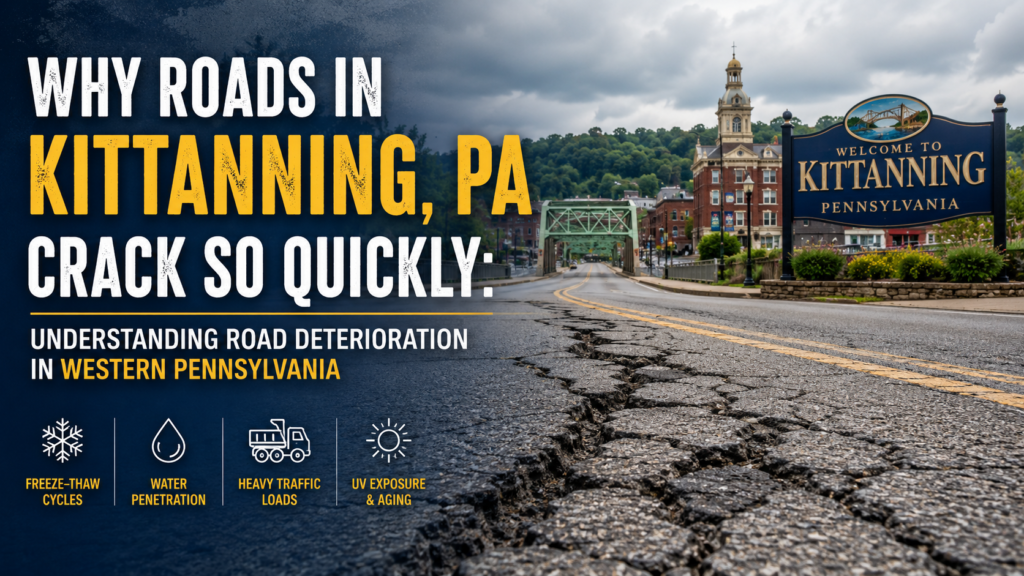
If you live or drive in Kittanning, Pennsylvania, you have almost certainly noticed that roads crack, heave, and develop potholes at a rate that can seem alarming particularly in the weeks following winter. Armstrong County’s roads are not uniquely poor in construction, and local contractors are not systematically cutting corners. The reality is that Kittanning sits in one of the more challenging pavement environments in the eastern United States, where the intersection of local geology, topography, climate, and traffic loads creates conditions that test road surfaces relentlessly. Understanding exactly why roads in Kittanning crack so quickly and what Road Construction In Kittanning practices address these causes is essential context for anyone living or building infrastructure in the area.
The Freeze-Thaw Cycle: The Primary Culprit
Of all the forces acting on roads in Kittanning, Pennsylvania’s freeze-thaw cycle is the most powerful and most consistent destroyer of pavement. Here is the mechanism in detail: water enters any crack, joint, or pore in the road surface through rain, snowmelt, or condensation. When temperatures drop below 32°F, that water freezes. Ice occupies approximately 9 percent more volume than liquid water. This expansion is not abstract it exerts pressure of up to 150 pounds per square inch on the surrounding pavement material. The crack or void that admitted the water is forced wider by the expanding ice. When temperatures rise and the ice melts, the water can now penetrate deeper into the slightly widened crack. The next freeze widens it further. Each cycle of freezing and thawing advances the damage.
Kittanning’s climate delivers this cycle repeatedly and unpredictably. Armstrong County experiences an average of 30 to 40 freeze-thaw cycles per year days when temperatures cross the 32-degree threshold at some point during the 24-hour period. This cycling is not limited to deep winter; it can begin in late October and continue through March or even April, with spring’s alternating warm days and cold nights being among the most damaging periods of the pavement year.
Western Pennsylvania’s Geology Compounds the Problem
The geology beneath Kittanning’s roads contributes significantly to their deterioration rate. Armstrong County’s soils include substantial clay content particularly in the valley soils along the Allegheny River and its tributaries. Clay soils are highly problematic for road foundations because:
- They absorb and retain moisture: Clay has a high water-holding capacity. When clay under or near a road becomes saturated as it does during wet Pennsylvania springs it loses load-bearing capacity. The road surface, lacking adequate support, deflects under vehicle loads and cracks.
- They shrink and swell seasonally: Clay expands when wet and contracts when dry. This seasonal movement creates differential settlement beneath road surfaces some areas rise, others sink producing the uneven, cracked surfaces characteristic of roads on clay sub-grades.
- They are particularly vulnerable to frost heave: When moist clay freezes, the ice crystal formation in the clay matrix causes significant vertical expansion frost heave that can lift road surfaces by inches. The differential heave between adjacent areas of varying moisture content produces cracking patterns that are particularly visible on Kittanning’s roads in early spring.
Beyond clay, Armstrong County’s underlying bedrock includes shale formations that weather relatively rapidly when exposed during road construction. Shale that is disturbed during grading or excavation disintegrates when exposed to air and moisture, creating unstable sub-grade conditions that contribute to settlement and cracking of the road surface above.
The Terrain of Armstrong County
Kittanning’s location in the Allegheny River valley, surrounded by the rolling hills of Western Pennsylvania, creates terrain-related road deterioration factors beyond those found in flat-terrain environments:
- Drainage concentration: Hillside terrain concentrates runoff into the valleys and hollows where many Kittanning roads run. This concentrated flow crosses roads in patterns that can undercut road edges and sub-bases, create erosion channels alongside pavement, and deposit sediment that clogs drainage structures.
- Steep grades: Roads that climb and descend Armstrong County’s hills must manage both the forces of heavy vehicles braking on descents (which concentrates shear stress on the pavement surface) and the accelerated drainage flow that steep grades produce. Both contribute to faster surface wear.
- Culvert loading: Many county roads in the Kittanning area cross streams and drainage channels on culverts. When these culverts are undersized, age-damaged, or blocked, they back up water against road embankments, saturating the base and sub-grade and causing accelerated structural failure.
Road Construction Practices That Address Kittanning’s Conditions
Understanding the mechanisms of road deterioration in Kittanning points directly to the construction practices that address them. Good road construction in Armstrong County does not simply resist deterioration better it actively counters the specific forces that would otherwise destroy pavement quickly:
- Adequate sub-base depth: In areas with problematic clay sub-grades, the aggregate base course beneath the asphalt must be thick enough to distribute vehicle loads over a sufficient area to prevent sub-grade deflection. For heavily trafficked roads in Armstrong County, this may mean 8 to 12 inches or more of properly graded aggregate base.
- Sub-grade drainage improvement: French drain systems, perforated pipe at the base of the aggregate layer, and daylighted drainage outlets lower the water table beneath the road base and prevent the saturation that leads to load-bearing failure. This subsurface drainage is perhaps the most important investment in road longevity in Western Pennsylvania.
- Appropriate asphalt binder grade: PennDOT specifies performance-grade (PG) asphalt binders for Pennsylvania roads that are appropriate for the temperature range of each region. For Western Pennsylvania, the binder must remain sufficiently flexible at cold temperatures to resist cracking under thermal stress and freeze-thaw movement. Using the correct binder grade for the local climate is a technical requirement that directly affects how quickly roads crack.
- Proper compaction: Inadequately compacted asphalt rushed installation at temperatures too low for proper compaction, insufficient roller passes, or failure to achieve design density produces a permeable, structurally weak surface that deteriorates far faster than a properly compacted pavement.
The Role of Maintenance in Road Longevity
Even well-constructed roads in Kittanning will develop surface cracks over time the climate simply demands it. The difference between a road that lasts 25 years and one that fails in 10 is largely determined by whether those surface cracks are addressed before they become structural failures. Crack sealing applying flexible sealant to surface cracks before winter is the highest-return maintenance investment for Armstrong County roads. A road that is crack-sealed every year before the freeze season can prevent the winter’s freeze-thaw cycling from advancing cracks into structural damage, dramatically extending the interval before expensive overlay or reconstruction is required.
PennDOT publishes pavement management guidance that municipal road authorities in Armstrong County can use to plan maintenance cycles that maximize the service life of their road networks within available budget. Local contractors familiar with PennDOT specifications and Armstrong County’s specific conditions are valuable partners in developing and executing these maintenance programs.
Conclusion
Roads in Kittanning crack quickly because of the perfect storm of conditions that Western Pennsylvania presents: relentless freeze-thaw cycling, clay-rich soils with moisture sensitivity, challenging hilly terrain that concentrates drainage, and the cumulative effects of Pennsylvania’s heavy seasonal precipitation. These are not problems that can be fully prevented they can only be mitigated through thoughtful road design, proper construction practice, and committed preventive maintenance. Understanding these causes helps Kittanning residents, property owners, and road managers approach road construction and maintenance decisions with realistic expectations and an appreciation for the genuine technical challenge that Western Pennsylvania’s environment presents.